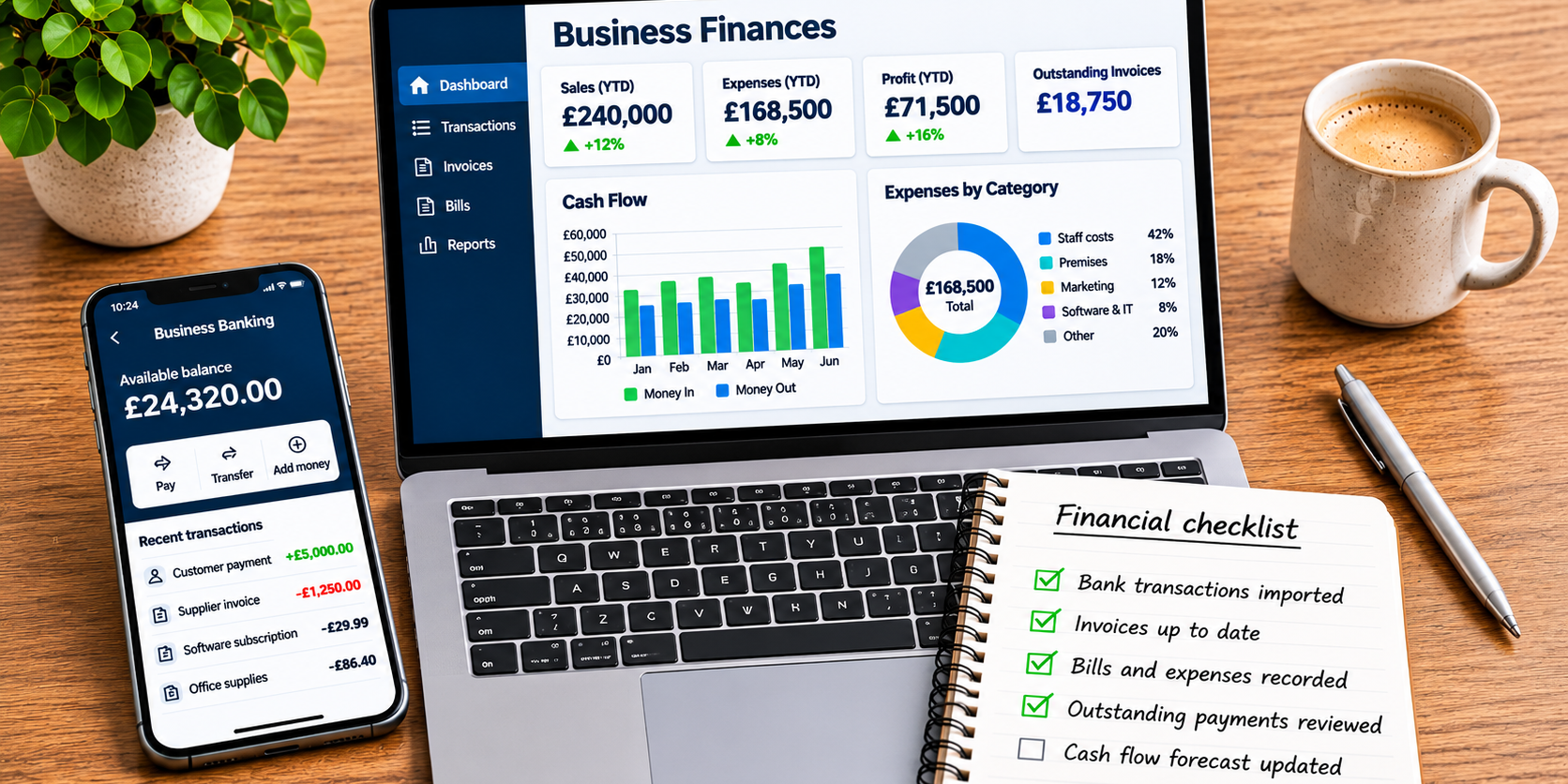
Business banking apps have made managing day-to-day finances easier than ever. You can check payments, photograph receipts, categorise spending, and keep track of your balance, all from your phone.
Providers such as Monzo, Starling, and Tide now offer bookkeeping features and connections to accounting software too. But while these tools can save time, are they giving you a complete picture of your business finances?
What Can Business Banking Apps Do?
Modern business banking apps offer much more than a bank balance and transaction history.
For example, Monzo connects with accounting software, including Xero, Starling offers its own accounting tools alongside external integrations, and Tide provides bookkeeping features and a Xero Connector.
You can explore the options through Monzo’s accounting tools, Starling Accounting, and Tide’s Xero Connector.
These features can make record-keeping much easier. However, categorising transactions isn’t necessarily the same as maintaining complete business accounts.
Your Bank Balance Doesn’t Tell the Whole Story
One of the biggest misconceptions is that money coming into your bank account automatically represents business income.
For example, imagine your business normally generates £20,000 in monthly sales, but you also transfer £10,000 from another business account.
Your banking dashboard might show £30,000 coming in, but that doesn’t mean you’ve made £30,000 in sales.
Similarly, receiving a business loan increases your bank balance but isn’t sales income. Buying equipment may also need different accounting treatment from everyday running costs.
And what about the transactions that haven’t happened yet? Unpaid customer invoices and outstanding supplier bills can significantly affect your financial position without appearing in your bank transactions.
A banking app can be excellent for monitoring cash, but cash and profit are not the same thing.
How Does Xero Fit In?
Accounting software such as Xero can bring together bank transactions, invoices, supplier bills, and financial reports, providing a more complete picture of your business.
Monzo, Starling, and Tide all offer ways to connect with Xero, although the information transferred varies.
The important thing is ensuring everything works together properly. For example, if you’re uploading receipts through your banking app, will they also appear in Xero? Could creating invoices or recording expenses in two systems result in duplicates?
Some integrations also require careful setup. Tide’s Xero Connector guidance explains that its category mappings can override existing categorisation rules in Xero.
It’s worth agreeing with your accountant which system will hold your main accounting records and how information should flow between them.
Can Your Accountant Access Everything They Need?
Not all banking apps offer the same level of account access.
Starling provides view-only business account access, while Tide offers different team access roles. Monzo provides document-export options where read-only business account access isn’t available.
You can find more information through Starling’s guidance, Tide’s access information, and Monzo’s accounting guidance.
The key question is whether your accountant can access the transactions, receipts, and supporting information needed to maintain accurate records.
Are You Paying for Features You Don’t Need?
If you’re paying for bookkeeping features through your banking app and also subscribing to accounting software, it’s worth reviewing whether you’re getting value from both.
There’s nothing wrong with using multiple tools if they’re saving time and improving accuracy. But overlapping subscriptions, duplicated work, and information that doesn’t transfer between systems can create unnecessary costs and administration.
Getting the Full Financial Picture
Business banking apps can be incredibly useful, and for some businesses, their integrated accounting features may be sufficient.
For others, dedicated accounting software will be more appropriate, particularly as the business grows.
Ultimately, it’s not about having the most software or the cleverest dashboard. It’s about having accurate, complete financial information that helps you make better business decisions.
At Greystone Advisory, we help businesses make sense of their numbers and ensure their banking and accounting tools are working effectively together.
Not sure whether your current setup is giving you the full picture? Get in touch and let’s take a look.